
LLC vs. S-Corp vs. C-Corp: Which Structure Actually Wins?

Choosing the right legal structure for your business is like picking the perfect tool for the job. It can make all the difference. Today, we're diving into the wild world of business entities: Limited Liability Company (LLC), S-Corporation (S-Corp), and C-Corporation (C-Corp). Strap in, because we're about to decode the complexities and unveil the secrets behind each option.
Unraveling the Mystery: LLC vs. S-Corp vs. C-Corp
What is a Limited Liability Company (LLC)?
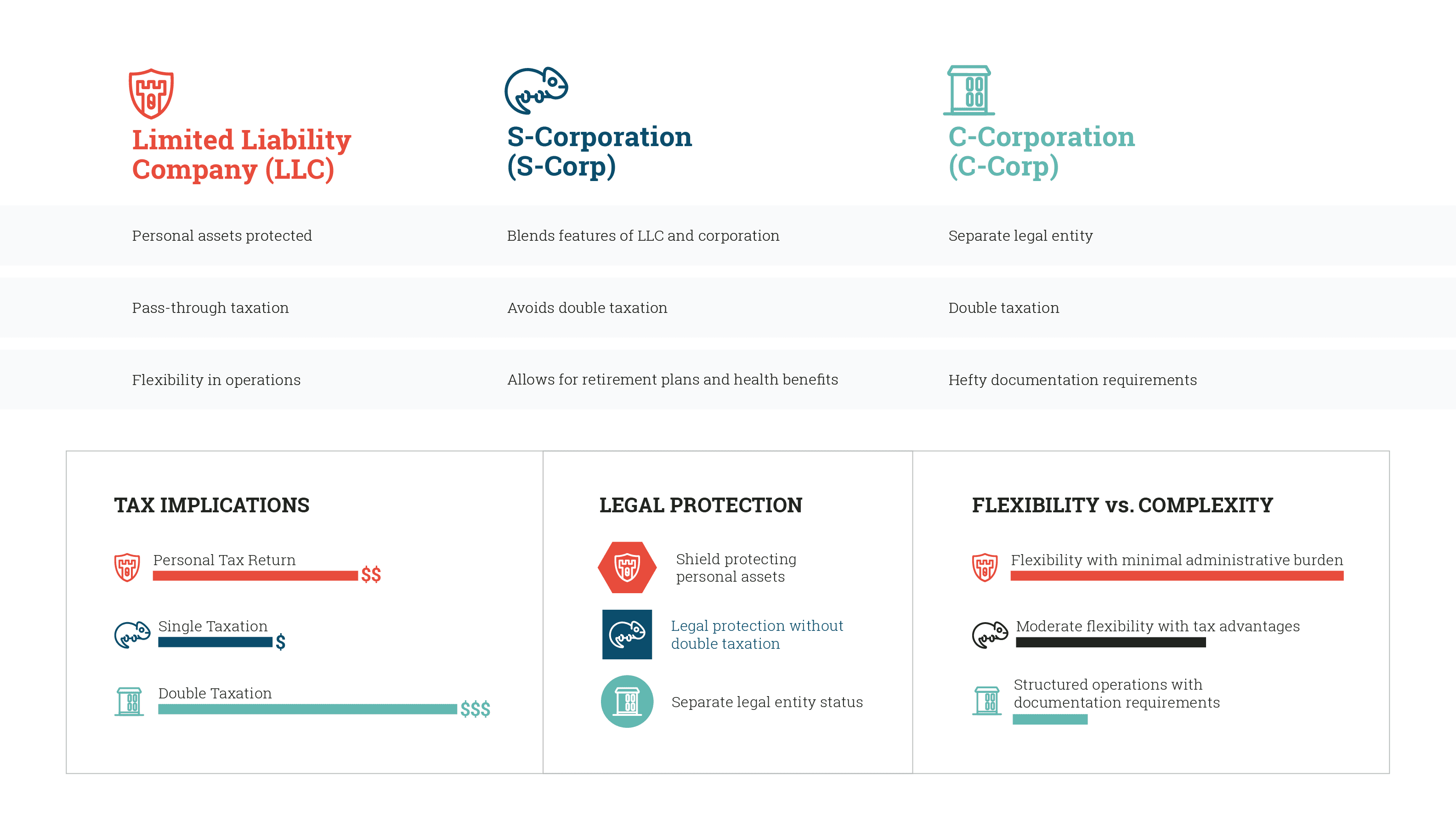
Think of an LLC like a superhero cape for your business. It protects your personal assets from any mishaps that might happen to your venture.
LLCs offer the best of both worlds: the security of a separate legal entity and the flexibility to operate according to how you want. However, here's the catch: while it may shield you from financial calamity, tax-wise, it's not the most thrilling option.
Why not? LLCs are subject to taxation on business income as self-employment taxes, including the hefty 15.3% FICA (self-employment) tax. So your income still finds its way onto your personal tax return, much like it would without the fancy LLC label. And that typically means less money in your pocket.
What is a C-Corporation (C Corp or C-Corp)?
Ever dreamed of having your own corporation? Well, here's your chance.
What C-Corps can offer that other structures do not are pre-tax benefits like Medical Flexible Spending Accounts (FSAs) and Dependent Care FSAs, providing additional incentives for employees and shareholders alike.
Picture a C-Corp as the corporate bigwig. It's got all the bells and whistles, but with great power comes great responsibility. C-Corps come with hefty documentation requirements and the dreaded double taxation curse.
Yep, you heard that right. Profits get taxed at the corporate level, and then Uncle Sam comes knocking again when dividends or payroll are doled out to shareholders. Like paying taxes on your taxes. Ouch.
What is an S-Corporation (S Corp or S-Corp)?
Now meet the S-Corp, a dynamic hybrid entity that combines the best traits of both LLCs and C-Corps while sidestepping their drawbacks.
Think of the S-Corp as the chameleon of business structures: it seamlessly adapts to your needs, offering the legal protection of a corporation without the headache of double taxation and cumbersome corporate reporting.
S-Corps are akin to the savvy sidekicks in the business world. They shoulder the FICA tax burden only on payroll wages, sparing you from that hefty 15.3% tax on dividends once they surpass the "reasonable wage" threshold. It's like having your cake and eating it too, with a generous side of tax savings to boot.
But wait, there's more. With an S-Corp, you can unlock additional benefits like setting up a retirement plan, capitalizing on substantial tax savings, and accessing coveted health insurance perks. It's the business structure that keeps on giving.
S Corp vs. C Corp: The Real Head-to-Head
Since these two get lumped together so often, here's the direct comparison. An S-Corp's profits pass through to your personal return and get taxed once, at your rate. A C-Corp is its own taxpayer entirely: the corporation pays tax on its profits, and then you pay tax again on anything it distributes to you. That's the double taxation curse we mentioned above, and it's the single biggest reason most freelancers and small business owners lean S-Corp over C-Corp.
So why would anyone still choose a C-Corp? A few real scenarios: you're raising venture capital (investors tend to prefer C-Corps), you want to reinvest profits into the business instead of taking them out, or you're building toward a specific kind of exit down the road. S-Corps also cap out at 100 shareholders who all have to be U.S. citizens or residents, so if you're planning to bring on international investors or a large shareholder base eventually, that cap matters.
Shareholder limit: S-Corp caps out at 100 shareholders, all of whom must be U.S. citizens or residents. C-Corp has no shareholder limit and no citizenship restriction.
Fundraising fit: S-Corp is harder to raise VC money with. C-Corp is the preferred structure for outside investors.
For almost everyone reading this though, the C-Corp's advantages don't apply, and the double taxation outweighs whatever else it offers.
Navigating the Maze: Which Structure Is Right for You?
Feeling overwhelmed by the business entity labyrinth? Let Opolis be your guiding light through the murky waters of LLCs, S-Corps, and C-Corps.
Whether you're a lone wolf or building an empire, Opolis helps you navigate tax efficiency and legal protection. Say goodbye to confusion and hello to clarity with our expert guidance. If you're still weighing an LLC against staying a sole proprietor in the first place, we've laid out that comparison separately.
FAQs
What's the difference between an LLC and an S-Corp? An LLC is a legal structure. An S-Corp is a tax election you can apply on top of an LLC. Most freelancers start as an LLC and elect S-Corp status once their profit is high enough to make the payroll and filing overhead worth it.
S-Corp vs. C-Corp, what's the real difference? An S-Corp's profits pass through to your personal return and get taxed once. A C-Corp is taxed at the corporate level, then taxed again when it distributes profits to you, the classic double taxation problem.
LLC vs. S-Corp vs. C-Corp, which should I actually pick? Start as an LLC. Elect S-Corp status once your profit justifies the added payroll and filing work. Only consider a C-Corp if you're raising outside investment or building toward a specific kind of exit.
Is an S-Corp or C-Corp better for a small business? For most freelancers and small business owners, S-Corp wins, since you avoid double taxation and still get liability protection. C-Corp makes sense mainly if you're raising venture capital or planning a specific kind of exit.
What is the difference between a C-Corp and an S-Corp for taxes specifically? The core tax difference is who gets taxed and how many times. S-Corp income passes through to your personal return once. C-Corp income is taxed at the corporate level, then taxed again as a dividend when it reaches you.
Ready to Make Your Move?
Tired of the guesswork and ready to take the plunge? Opolis is here to assist you, whether you prefer the simplicity of an LLC, the prestige of a C-Corp, or the versatility of an S-Corp. Say goodbye to business structure woes and hello to peace of mind with our seamless setup process. Got more questions along the way? Our FAQ has you covered, or check out how the Opolis cooperative handles the payroll and compliance side once you're set up.
Ready to unleash your independent worker prowess? Get in touch with us today to explore your business structure options and embark on a journey to success.
Email memberships@opolis.co now to get started.