
Built a Successful Consultancy? Now Optimize It.
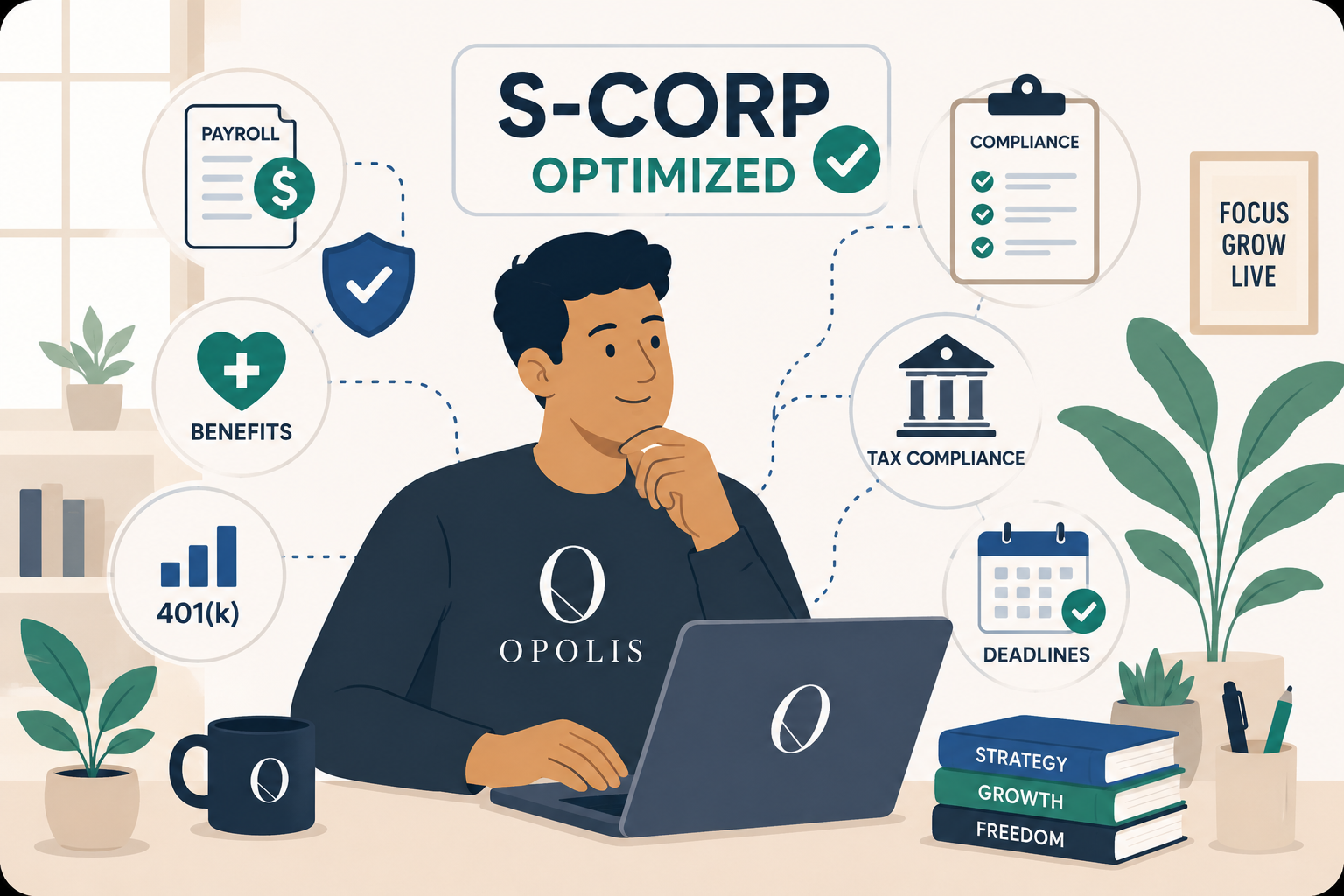
If you're reading this, you're probably past the "should I incorporate" question. You've got your S-Corp, a CPA who files your return, and a consulting business that's actually working. Hell yeah! The hard part's done.
What usually isn't done: payroll, benefits, and compliance still running on duct tape. A payroll software subscription here, a health insurance marketplace plan there, a workers' comp policy you set up once and haven't looked at since. It works, technically. It's also quietly costing you more than you think.
The part your CPA doesn't cover
A CPA files your taxes. They may even run your payroll, register and administer your state withholdings and unemployment licenses, and keep an eye on whether the IRS thinks your "reasonable salary" is actually reasonable. But really, that's a separate job, and trust us when we say "your CPA doesn't want to do that sh*t any more than you do!" (Here's how Opolis actually handles tax compliance and CPA collaboration, if you're curious what the alternative looks like.)
Most consultants end up with some version of this stack:
A payroll tool to cut yourself a W-2 paycheck
A health insurance plan bought as an individual, at individual rates, with none of the leverage a group plan gets
A 401(k) set up (or not) on your own
Workers' comp and unemployment registration handled state by state, manually
A mental tally of deadlines nobody else is tracking for you
Bookkeeping software that is overly complicated and tedious to manage
None of it is hard, exactly. All of it adds up to hours that aren't billable and a level of coverage that's a step down from what you had in corporate.
What "optimizing" actually means
Optimizing isn't starting over. It's offboarding the parts of running an S-Corp that were never actually your job to begin with, like payroll, employment compliance, and benefits administration, and keeping the parts that are, such as doing the consulting work you're good at.
Done right, it also means you stop trading down on benefits. Leaving a corporate job for independent consulting usually means a real drop in benefits, worse health plans, no group 401(k) match, and thinner disability coverage, if you carry it at all. That trade-off isn't required. It's just what happens when nobody's negotiating group rates on your behalf.
What the best setup actually looks like for an S-Corp consultant
Most consultants comparing payroll services end up choosing between three flawed options.
DIY it with a payroll app, a health insurance broker, and a separate 401(k) provider. Three vendors, three logins, three bills, zero group leverage.
A generic payroll service that runs your paycheck and stops there, leaving benefits as your problem.
A PEO, which usually means becoming a co-employee of the PEO itself, giving up ownership of your S-Corp relationship in exchange for group rates, but retaining a lot of the employment headaches, like state licenses under your entity, to be managed.
Opolis is built to be the fourth option. It's a Member-owned Employer-of-Record (EOR), not a PEO, and not interchangeable with one, built specifically for independent professionals running their own S-Corp or C-Corp. One membership replaces the payroll app, the broker, and the 401(k) provider, giving you W-2 payroll run through your own business, group health benefits, a 401(k), workers' comp, and unemployment coverage, all in one place.
Because it's Member-owned, you're not renting a service forever. Employee Members hold a voting share in the cooperative alongside the benefits package, and instead of stacking separate vendor fees, you pay one Cooperative Fee, a percentage of your gross payroll and benefits, for the whole thing. No VCs or PE firms to bleed you dry, but instead, a collective group of independent consultants, solopreneurs, and freelancers coming together to build and benefit from a cooperative with long-term sustainability in mind.
See how Opolis membership works for the full breakdown of what's included and what it costs.
Fortune 500-level benefits, running through your own business
This is the part that surprises most consultants. The benefit quality doesn't have to shrink just because the W-2 disappeared. Through Opolis, Employee Members get access to:
Group health insurance (medical, dental, vision)
HSA/FSA options
Life insurance
Short- and long-term disability coverage
A 401(k)
Workers' compensation
Unemployment insurance
Same caliber of coverage you'd expect at a large employer, just running through the S-Corp you already built, instead of a W-2 job you don't want. See how Opolis Members are maximizing their self-employed benefits for real examples of what that looks like.
What happens when your COBRA coverage runs out
A lot of consultants land here after leaving a corporate job. You elected COBRA to keep your old employer's health plan, and it's worked, but it's temporary, and it's often quite expensive. COBRA typically only lasts 18 to 36 months, and you're paying the full premium yourself, usually more than what your former employer was covering, plus a 2% admin fee on top.
Once COBRA runs out (or once you decide the premium isn't worth it anymore), independent consultants are usually left picking from:
ACA marketplace plans, bought as an individual, at individual rates, with coverage that varies a lot by state and plan tier
A spouse's employer plan, if that's available
Short-term or catastrophic plans, which are cheaper but come with real coverage gaps
A group plan through an Employer-of-Record, which is the only option on this list that gets you back to group-rate, group-quality coverage instead of shopping as an individual
That last option is where Opolis fits. Employee Members get access to group health benefits through their own S-Corp or C-Corp, the same category of coverage COBRA was extending from your old job, except it doesn't expire on a timer. If COBRA has been a bridge, this is usually what people are looking for on the other side. Don't sacrifice premium benefits simply because you're now working for yourself!
FAQ
What's the best payroll service for an S-Corp owner?
Standalone payroll tools handle the paycheck, but nothing else. Benefits, compliance, and workers' comp are still on you. An Employer-of-Record like Opolis runs payroll through your own S-Corp while also bundling group benefits and compliance into the same membership, which is usually a better fit once you're past the "just cut me a check" stage.
Can independent consultants get corporate-level benefits?
Yes. Group-quality health, dental, vision, disability, and 401(k) benefits aren't exclusive to traditional employment. Member-owned Employers-of-Record like Opolis pool independent S-Corp and C-Corp owners together to access group rates and coverage that individuals can't get on their own.
What does an Employer-of-Record do for independent consultants?
An EOR runs W-2 payroll, compliance, and benefits administration on behalf of a business, in this case, your own S-Corp or C-Corp, so you're not handling payroll tax filings, state unemployment registration, or benefits enrollment yourself.
Is Opolis a PEO?
No. Opolis is an Employer-of-Record and a Member-owned cooperative, not a PEO. You keep your S-Corp or C-Corp as the business entity. Opolis handles payroll, compliance, and benefits on top of it, and as a Member you hold a share in the cooperative itself rather than just paying for a service.
What are my options when I lose COBRA coverage as an independent consultant?
Once COBRA ends (or becomes too expensive to pay out of pocket), most independent consultants choose among an ACA marketplace plan, a spouse's employer coverage, a short-term plan, or joining a group health plan through an Employer-of-Record. The EOR route is the only one that gets you back to group rates and group-quality coverage, rather than shopping as an individual, and it doesn't expire on a fixed timeline the way COBRA does. Joining Opolis is a Qualifying Life Event (change of employer), so you can start benefits throughout the year without waiting for the next Open Enrollment season.
How much mindshare does managing your own back office actually cost?
Hard to put an exact number on it, but between payroll runs, compliance deadlines, and benefits shopping, most consultants lose several hours a month to admin that doesn't move client work forward; time that's worth more spent billing or on business development.