
How S-Corp Payroll Saves Freelancers Thousands in Taxes
If you've made the jump from 1099 to S-Corp, you probably did it for the tax savings. But there's a catch nobody explains well: an S-Corp doesn't let you just pay yourself whenever you feel like it. You have to run payroll. Real payroll, with tax withholding, W-2s, and all the compliance that comes with employing someone, even when that someone is you.
Here's how S-Corp payroll actually works, and why it's the mechanism that makes the tax savings real in the first place. This is how switching to an S-Corp saves money for most freelancers, and how S-Corp vs 1099 payroll actually plays out once you make the switch.
What is S-Corp payroll, and why is it different
When you're a 1099 contractor or sole proprietor, all your business income is subject to self-employment tax. Every dollar is taxed the same way.
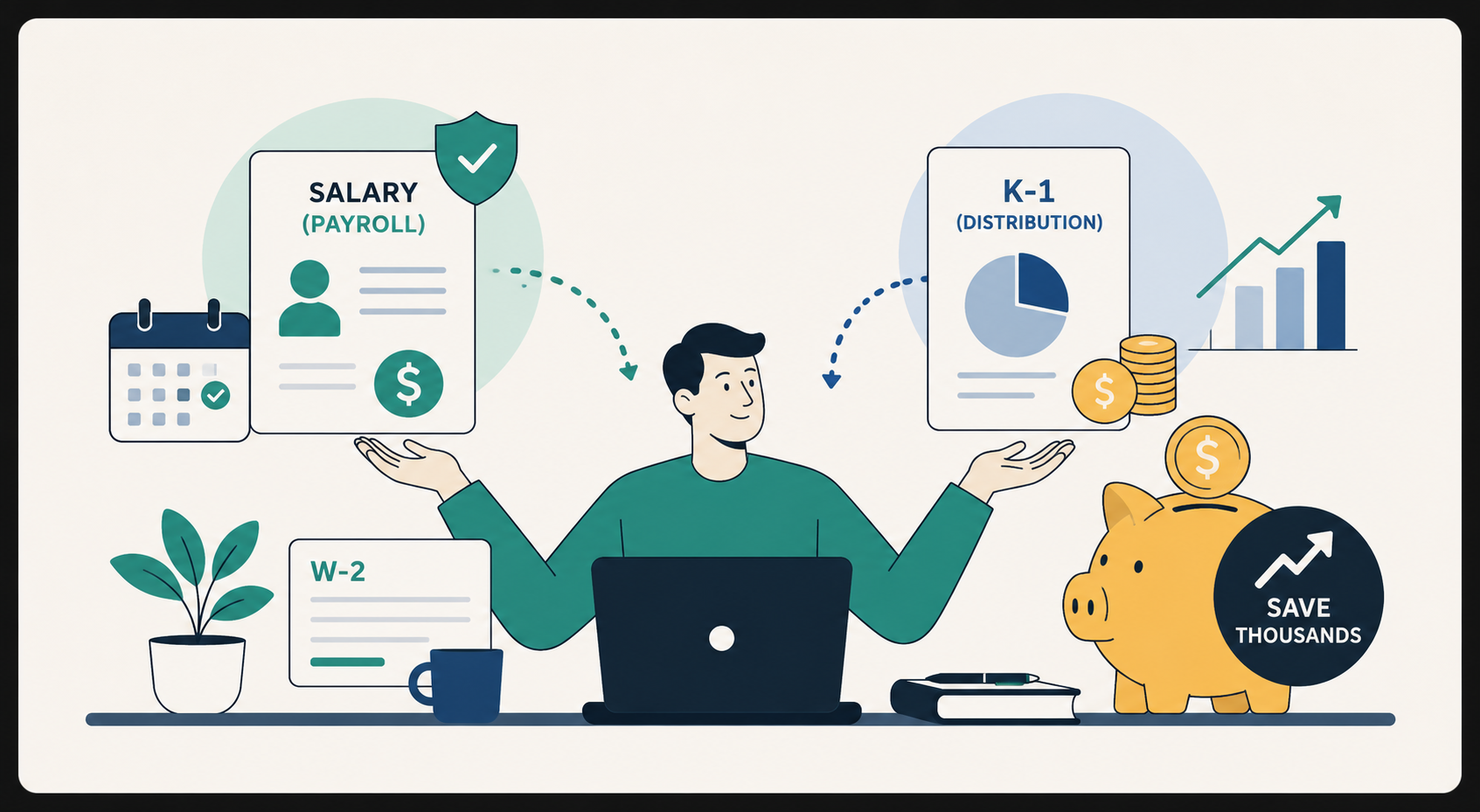
An S-Corp changes that. The IRS treats you as both the owner and an employee of your business. That means your income splits into two buckets:
Salary: what your business pays you as an employee, run through payroll, subject to standard S-Corp payroll taxes
K-1 distribution: your share of remaining business profit, paid out separately, not subject to payroll tax
Splitting income this way is exactly what creates the tax advantage. But the IRS only allows it if you run actual payroll for the salary portion. Pay yourself only in distributions with no salary, and you're inviting an audit.
If you haven't set up your entity yet, it's worth understanding why an entity structure matters before you get into payroll mechanics.
The reasonable salary rule explained
The IRS calls this the reasonable salary rule. Your S-Corp must pay you a salary that reflects what someone would reasonably earn for your job in your industry and location. Underpay yourself on salary to shift more income into distributions and dodge payroll tax, and the IRS can reclassify that distribution as wages, along with penalties and back taxes. The IRS's own guidance on S-Corp compensation lays out the standard directly: distributions must be treated as wages to the extent they represent reasonable compensation for services rendered.
There's no single formula the IRS publishes, but the standard is what similar roles pay in the market. A freelance developer billing $150K a year can't reasonably pay themselves a $20K salary. Most freelancers land in the range where salary covers a solid, defensible share of what they'd earn as a W-2 employee doing the same work, with the remainder distributed as K-1.
If you're still deciding whether an S-Corp is the right move, this walkthrough on creating your S-Corp covers the setup.
How K-1 distributions work alongside your salary
Once your reasonable salary is set and running through payroll, the rest of your business profit can be paid out as a K-1 distribution. Distributions:
Aren't subject to Social Security or Medicare tax (FICA)
Still counts as taxable income on your personal return
Get reported on Schedule K-1, not a W-2
This is the core mechanic. Your salary gets taxed like any employee's paycheck. Your distribution skips the self-employment tax layer entirely, the same 15.3% tax you'd otherwise owe on every dollar as a sole proprietor. That gap between the two is where the savings live.
If you're still paying quarterly estimated taxes as a sole proprietor, here's how that calculation works, and it's worth comparing against what changes once you move to S-Corp payroll.
Real tax savings example
Say your S-Corp brings in $120,000 in net business income for the year, and you set a reasonable salary of $60,000, with the remaining $60,000 paid as a K-1 distribution.
As a 1099 contractor or sole proprietor, the full $120,000 is subject to self-employment tax at 15.3%, which works out to roughly $16,950 for the year.
As an S-Corp, payroll taxes apply only to your $60,000 salary, roughly $9,180 for the year. The $60,000 distribution isn't subject to FICA at all.
That's an estimated $7,700 to $7,800 in payroll tax savings, just from the salary/distribution split. Your exact numbers depend on your actual income, your reasonable salary determination, and your state, so treat this as a directional example and run your real numbers with a tax professional.
How Opolis runs your S-Corp payroll
This is the part most freelancers don't want to deal with themselves, and it's exactly what Opolis is built for.
As an Opolis member, your S-Corp's payroll runs through Opolis as your Employer of Record. You submit your salary through the portal, and Opolis handles tax withholding, W-2 issuance, employer tax remittance, and multi-state compliance, all without you needing to register as an employer in every state you work from. Your K-1 distributions stay exactly where they belong, outside of payroll, handled through your business as usual. If you want to see the mechanics laid out visually, here's how a member actually gets paid through Opolis.
On top of running your payroll correctly, Opolis members get access to employer-sponsored group benefits, something a solo S-Corp normally can't offer itself. That's the part of the equation that goes beyond tax savings: predictable payroll, real access to benefits, and none of the multi-state licensing headache of running it yourself. For a broader look at why consistent payroll matters beyond just the tax math, see how regular payroll sets you up for financial success.
Having an S-Corp is a membership requirement at Opolis, and that's by design. It's the structure that makes the whole model, the tax savings, the benefits access, and the simplified payroll work in the first place.
FAQ
What exactly makes S-Corp payroll the lever for tax savings? With an S-Corp, your income splits into two parts: a salary run through real payroll and subject to standard payroll taxes, and K-1 distributions covering your share of remaining profit. Only the salary is subject to FICA. Distributions aren't. That split, allowed only if you pay yourself a reasonable salary through actual payroll, is what creates the savings compared to 1099 income, where every dollar is hit by self-employment tax.
Can you give a simple example of how much I might save? A freelancer with $120,000 in net income who pays themselves a $60,000 reasonable salary and takes a $60,000 K-1 distribution would owe roughly $16,950 in self-employment tax as a 1099. As an S-Corp, only the $60,000 salary faces payroll tax, about $9,180, and the distribution avoids FICA entirely. That's roughly $7,700 to $7,800 in payroll tax savings, with actual results depending on your income, salary determination, and state.
How do I figure out a "reasonable salary" without a fixed IRS formula? The IRS standard is what someone would reasonably earn for your role, industry, and location, essentially market W-2 pay for comparable work. Underpaying, like a $20,000 salary on $150,000 of freelance income, risks the IRS reclassifying distributions as wages, with back payroll taxes, penalties, and interest. Most freelancers set a defensible salary that mirrors what they'd earn as an employee, with the remaining profit paid as a K-1. A CPA can help you document and defend the figure.
After switching to an S-Corp, do I still need to make quarterly estimated tax payments? Your salary runs through payroll with tax withholding, which covers much of your income and FICA tax on that portion. K-1 distributions are still taxable income and typically aren't withheld through payroll, so you may still need to make or adjust estimated payments for the distribution portion. Compare your prior 1099 estimates to the new mix of withholding plus K-1 income, and run your real numbers with a tax professional.
How does Opolis simplify S-Corp payroll, especially across multiple states? Opolis acts as your Employer of Record. You set your reasonable salary, submit it through the portal, and Opolis handles the mechanics, tax withholding, employer tax remittance, W-2 issuance, and multi-state compliance, so you don't have to register as an employer in every state you work from. Your K-1 distributions stay outside payroll and flow through your S-Corp as usual. Members also gain access to employer-sponsored group benefits that most solo S-Corps can't obtain on their own.