
S-Corp vs 1099: Which Is Actually Better?
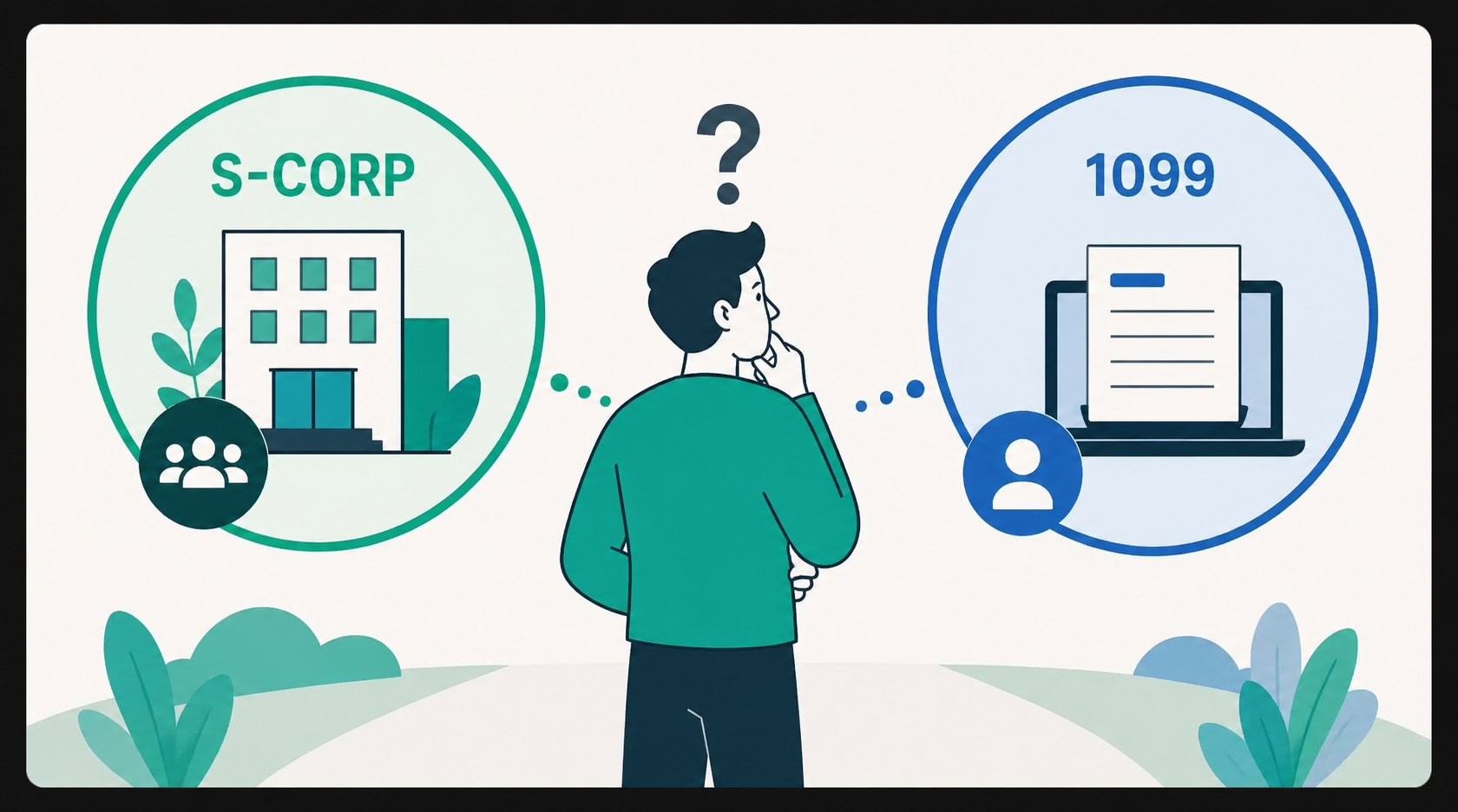
If you're self-employed, you've probably landed on one of two conclusions: either you love the freedom of 1099 life and tolerate the chaos, or you quietly wish you had the stability of W-2 employment without actually working for someone else. If you're comparing s-corp vs 1099 structures, you're not alone.
Here's the thing — you can have both. But it requires understanding what W-2 and 1099 status actually mean in practice, what each one costs you, and how an S-Corp changes the math entirely.
What W-2 Status Actually Means
When you're a W-2 employee, your employer handles a significant amount of administrative and financial infrastructure on your behalf — payroll tax withholding, quarterly tax deposits, year-end W-2 reporting, unemployment insurance, and workers' comp. You pay your half of FICA (7.65%) and your employer pays the other half. You get access to employer-sponsored benefits, and your tax obligations are managed every pay cycle so there's no end-of-year scramble.
The traditional catch: W-2 status has meant working under someone else's control, on their schedule, for their business.
What 1099 Status Actually Means
As a 1099 independent contractor, you invoice clients and collect your full payment. What most people don't fully account for is what comes next. You owe the entire 15.3% self-employment tax — both the employee and employer halves of FICA — plus federal and state income taxes, all paid quarterly on your own schedule through estimated payments.
You also need payroll licenses if you want to pay yourself formally, track every deductible business expense, fund your own retirement, and source health insurance on the individual market. There's no employer handling any of it. The administrative overhead is real, and the tax bill at year-end can be jarring if you haven't planned carefully.
For a deeper look at how this plays out annually, here's a side-by-side comparison of self-employed taxes: Opolis vs. going solo.
Where the S-Corp Changes Everything
If you operate as an S-Corp or C-Corp (which is required to work with Opolis), the tax picture shifts meaningfully. An S-Corp allows you to split your income into two buckets: a reasonable W-2 salary and K-1 profit distributions. You pay payroll taxes (FICA) only on the salary portion. The K-1 distributions are not subject to self-employment tax.
On $150,000 in revenue, for example, you might take a $75,000 reasonable salary and $75,000 in K-1 distributions. You pay FICA on $75,000 instead of the full $150,000. Compared to 1099 taxes, this is ~$10k in total tax savings — a material reduction in self-employment tax that compounds year over year. These mechanics are the source of s-corp tax savings for many independent workers.
Running payroll as an S-Corp also requires maintaining your own payroll licenses in every state where you operate, filing quarterly payroll reports, and staying current with federal and state employer tax obligations. Most independent workers either pay an accountant to manage this or avoid S-Corp election altogether because the overhead feels like too much. That's exactly the problem Opolis solves.
How Opolis Works
Opolis is a member-owned employment cooperative that serves as your Employer-of-Record (EOR). You run your S-Corp, set your compensation, and invoice Opolis through your entity. Opolis handles the rest, including multi-state payroll compliance.
Your invoice to your S-Corp covers everything on the employer side: your gross wages, all employer taxes (FICA, state, local, unemployment, and workers' comp premiums), and your benefit premiums. All of it is passed through to you at cost — Opolis charges a cooperative fee, not a markup on your taxes or benefits like most staffing or PEO companies.
What you get in return:
W-2 payroll processed on your behalf every cycle, with all withholdings handled
Quarterly payroll tax deposits and filings done for you, in every state, without you needing your own payroll licenses, ensuring multi-state payroll compliance
Access to group benefits — Cigna PPO and HDHP health insurance, dental, vision, 401(k), disability, life insurance, and more — at employer-group rates, essentially providing previously-unavailable group health insurance for contractors
Unemployment insurance and workers' comp are included
Year-end W-2 issued by Opolis, making tax filing straightforward for you and your accountant
The K-1 distributions from your S-Corp remain yours to take as you see fit. Opolis doesn't touch those — they run through your entity's own accounting. The combination of W-2 salary through Opolis and K-1 distributions from your S-Corp is one of the most tax-efficient structures available to self-employed people, and Opolis handles the payroll infrastructure side so you don't have to.
A Note on Benefits and S-Corp Tax Treatment
If you elect benefits through Opolis as an S-Corp owner, there's an important IRS rule to understand. The premiums your entity pays for your health, dental, and vision coverage are considered taxable income for S-Corp shareholders. As a result, your W-2 Box 1, Box 16, and Box 18 will be grossed up to include those premium amounts. They will also appear separately in Box 14 of your W-2, labeled 'SEBEN'.
This sounds like a penalty, but it isn't. You can deduct those same premium amounts on your personal return — Form 1040, Schedule 1, Part II, Line 17, the self-employed health insurance deduction. The net effect is that you're getting employer-sponsored group coverage at group rates, with a tax deduction to offset the reportable income. That's a substantially better outcome than sourcing individual market coverage with no deduction.
The Real Benefit: Predictability
The argument for Opolis isn't purely about tax savings — it's about the operational simplicity that comes with having your payroll, taxes, compliance, and benefits handled in one place.
No quarterly estimated payment panic. No scrambling for payroll licenses when you expand to a new state. No navigating the individual health insurance market every open enrollment. No building your own payroll system or paying an accountant to maintain one. Your W-2 is clean, your K-1 distributions are separate and straightforward, and your accountant has everything they need.
For independent workers who want the tax optimization of an S-Corp without the administrative burden of running one solo,understanding the full financial case for S-Corp election is a good place to start. Opolis is the infrastructure that makes it practical.
FAQ
Do I pay less in taxes as a W-2 employee through Opolis compared to a 1099 contractor?
The tax picture is more nuanced than a simple yes. As an Opolis member, you pay all employer taxes at cost, as they're passed through via your entity invoice. The meaningful savings come from the S-Corp structure itself: by splitting income between a reasonable W-2 salary and K-1 distributions, you reduce the portion of your income subject to FICA. How much you save depends on your revenue, your reasonable salary, and your state.
What does my invoice to my S-Corp actually include?
Your entity invoice from Opolis covers gross wages, all employer taxes (FICA, state and local payroll taxes, unemployment, and workers' comp premiums), and benefit premiums if you've elected coverage. Everything is passed through at cost. Opolis charges a cooperative fee on top of that — not a percentage of your taxes or benefits.
How do K-1 distributions work alongside my Opolis payroll?
Opolis runs your W-2 payroll. K-1 distributions are separate — they come from your S-Corp's retained earnings and are handled through your entity's own accounting. Your accountant or bookkeeper manages the K-1 side. Opolis handles everything on the payroll and employment side.
Do I need to maintain my own payroll licenses to work with Opolis?
No. Opolis handles all payroll filings and tax deposits on your behalf across all states where you operate. That's one of the primary operational benefits — you don't need your own payroll infrastructure or licenses.
What's required to join Opolis?
You need an S-Corp or C-Corp. If you don't have one yet, Opolis can help you set one up during onboarding. Check your eligibility here.